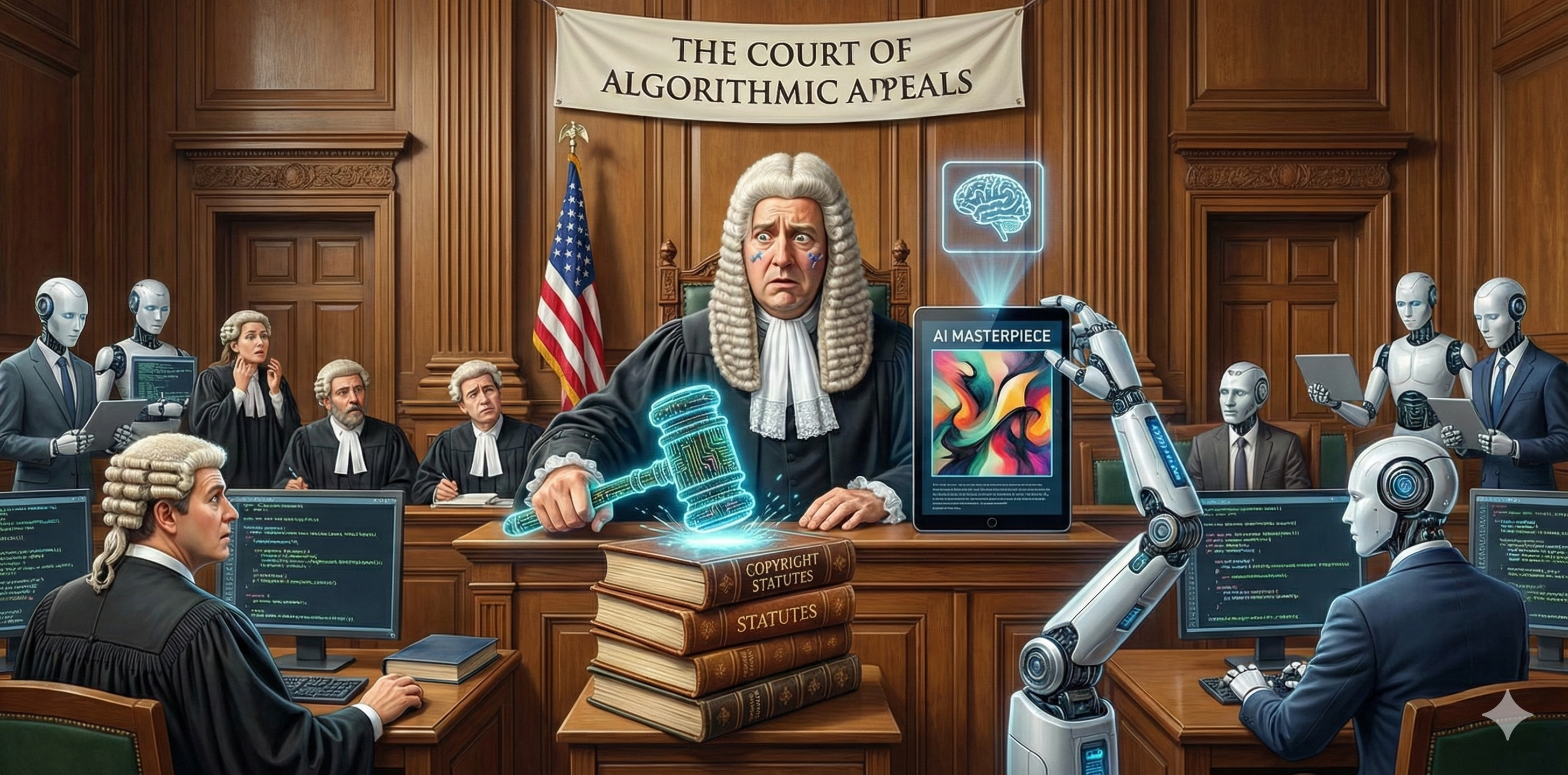
Copyright is experiencing one of its deepest identity crises, a legal odyssey made inevitable by the arrival of generative artificial intelligence. For decades the subject of copyright has remained relatively stable ground: a human author, a work, a date, a set of rights. Then came algorithms capable of ingesting the entire cultural production of humanity and regurgitating, upon request, new works that seem to have come from the hands of a professional. The most uncomfortable question arises in this short circuit: who is really the author, when what "creates" is a machine powered by billions of human contents?
The first flaw concerns authorship. No legislation recognizes machines as creative, yet the works generated by AI exist, work, move, win competitions and generate revenue. Regulations tend to recognize rights to those who provide the prompt or direct the creative process, but it is a fragile balance: an AI that carries out the "hard" work makes the work potentially unprotected, as the US guidelines indicate. A paradox arises from this: the so-called prompt engineers risk being considered, legally, little more than operators of an advanced photocopier.
The second critical front concerns the datasets used to train the models. Millions of texts, images, music, codes - often protected by copyright - are absorbed without authorization or compensation. In the United States, fair use has become the shield preferred by Big Tech, while in Europe the debate is more heated and the AI Act attempts to impose transparency on databases. For human authors, however, there remains the bitter sensation of seeing their creativity transformed into free fuel for machines that could replace them.
The complexity is not only legal but also economic. If software generates in seconds what an illustrator produces in hours, how much is human labor still worth? Defending copyright today means defending professional dignity, time, skills and the cultural heritage that has allowed AI to develop. The creativity of machines is in fact born from the creativity of people, and the risk is an infinite circle in which the contents generated by AI feed further models, progressively diluting the distinction between human and artificial.
The future, however uncertain, is not without possible solutions: specific licenses for training, registers for works generated with AI, collective compensation systems similar to musical ones. But we are still in a work in progress, in which technology runs faster than law and the central question remains unanswered: does it really matter who knows who created a work, or will we have to redefine the very concept of creativity?
Judging by the current chaos, the answer will be given by the judges. And maybe even cars.