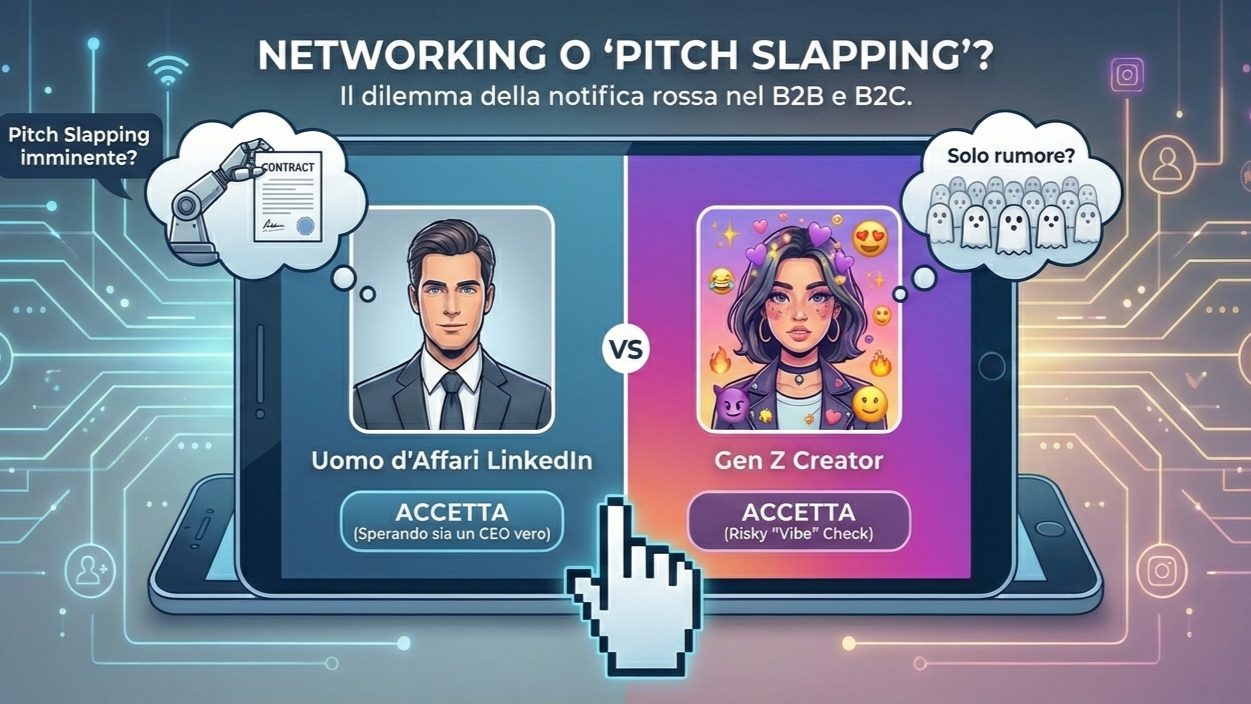
From Gen Z barricades to LinkedIn ambushes, here’s why your next notification could be a golden opportunity or just a one-way ticket to spam.
That little red notification flashing on the screen now holds the same hypnotic power as the Sirens’ song for Odysseus, with the only difference being that Odysseus didn’t risk finding a Dubai-based crypto-shill in his inner circle. As a marketing analyst, I spend my days staring at engagement charts, but the truth is that the decision to click "Accept" or "Ignore" has become the final frontier of digital anthropology. We are in the midst of a collective identity crisis: on one hand, a hunger for visibility that drives us to hoard contacts like vintage trading cards; on the other, a primal survival instinct suggesting that, perhaps, "John Smith" with his lazy AI-generated profile picture doesn't actually want to discuss the future of the luxury market.
In the Wild West of B2C, we’ve witnessed a hilarious generational paradox. While Boomers and segments of the Millennial population have turned Facebook into a sort of permanent village fair where anyone with a vaguely human face—including kittens and "Coffee Lover" profiles—is welcomed, Generation Z has erected barricades that would make a medieval fortress look flimsy. Today's youth practice a form of ruthless digital hygiene. For them, a public profile is merely a storefront; real life happens in private accounts, "Finstas," or "Close Friends" circles. Accepting a stranger on Instagram is seen almost as a home invasion. If you don’t have a compatible "vibe" or a curated aesthetic, your friend request will end up in the memory hole alongside old MySpace statuses. For brands, this means entering their circle is no longer about algorithms, but about a near-spiritual elective affinity.
Shifting to the glossy corridors of B2B, the situation becomes even more grotesque. LinkedIn has morphed into a theater of constant performance where accepting a connection request is often the prelude to a commercial ambush. There is a special category of professionals—let’s call them "serial networkers"—convinced that having thirty thousand connections is the digital equivalent of owning a private jet. They accept everyone, from multinational CEOs to the guy selling air conditioners in the desert, believing that critical mass leads to authority. Then there are the purists: those who won’t even look at you unless you have at least three mutual endorsements and a short essay explaining why you wish to connect, otherwise leaving you in the limbo of "pending requests" for eternity.
The risk in this grand charade is what I call "Pitch Slapping": that magical moment when you accept a distinguished-looking professional and, three seconds later, receive a sales pitch as long as a chapter of War and Peace, offering software solutions for problems you didn't know you had. This is where the irony of modern marketing shines in all its glory. We spend millions on data analysis to personalize the user experience, yet we end up acting like door-to-door encyclopedia salesmen from the last century.
Ultimately, accepting a stranger is either an act of faith or a chess move. If your goal is aggressive personal branding, open the gates and brace yourself for the background noise. If you’re looking for quality, remember that a clean feed is worth more than a thousand ghost followers who don’t even know your name. In this office, the golden rule remains: if the profile lacks a personalized note or looks too perfect to be true, it’s probably just a bot trying to steal your time or, even worse, sell you a course on how to get rich by collecting seashells.